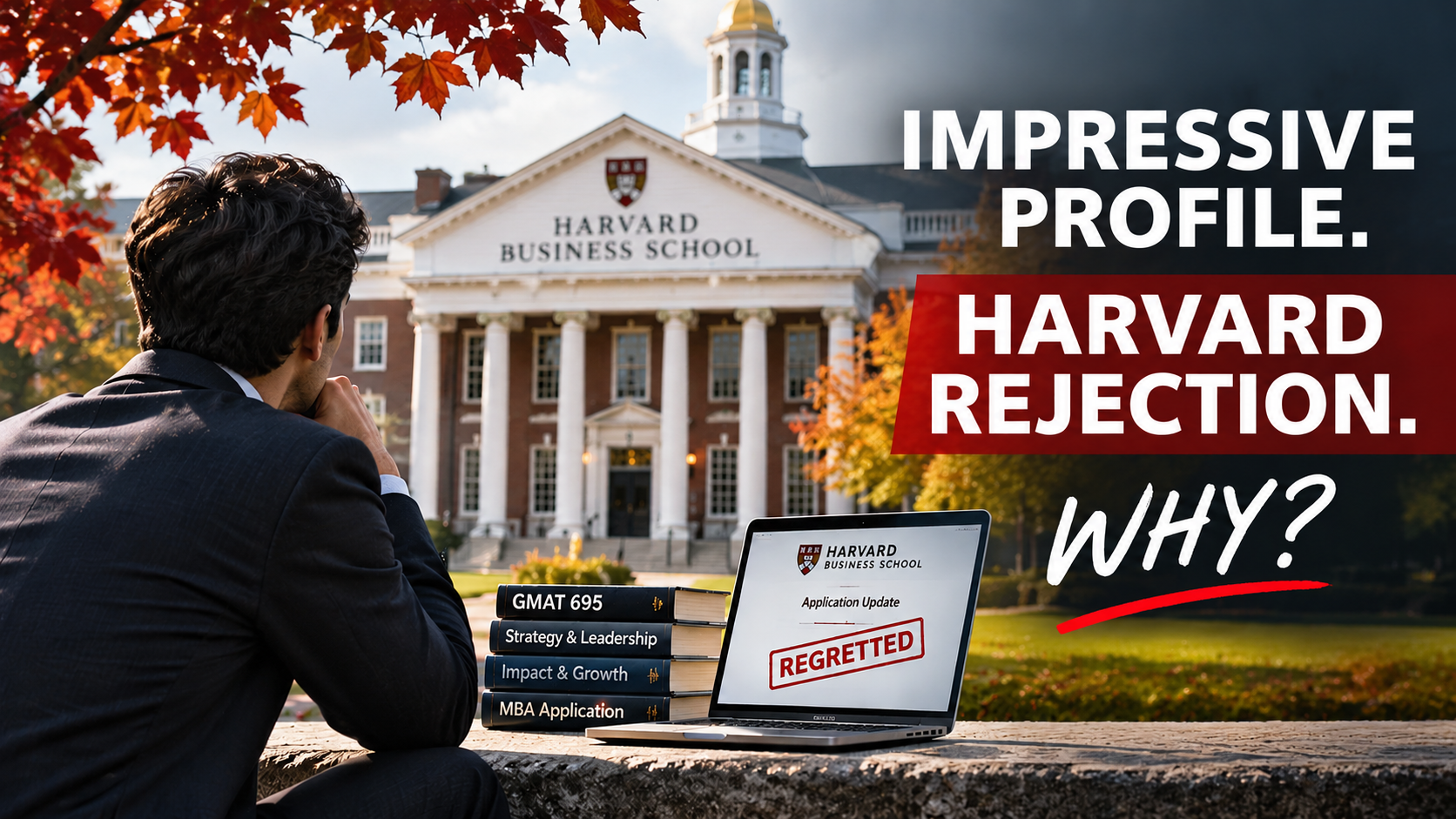
· · 11 min read
Let's meet Alex.
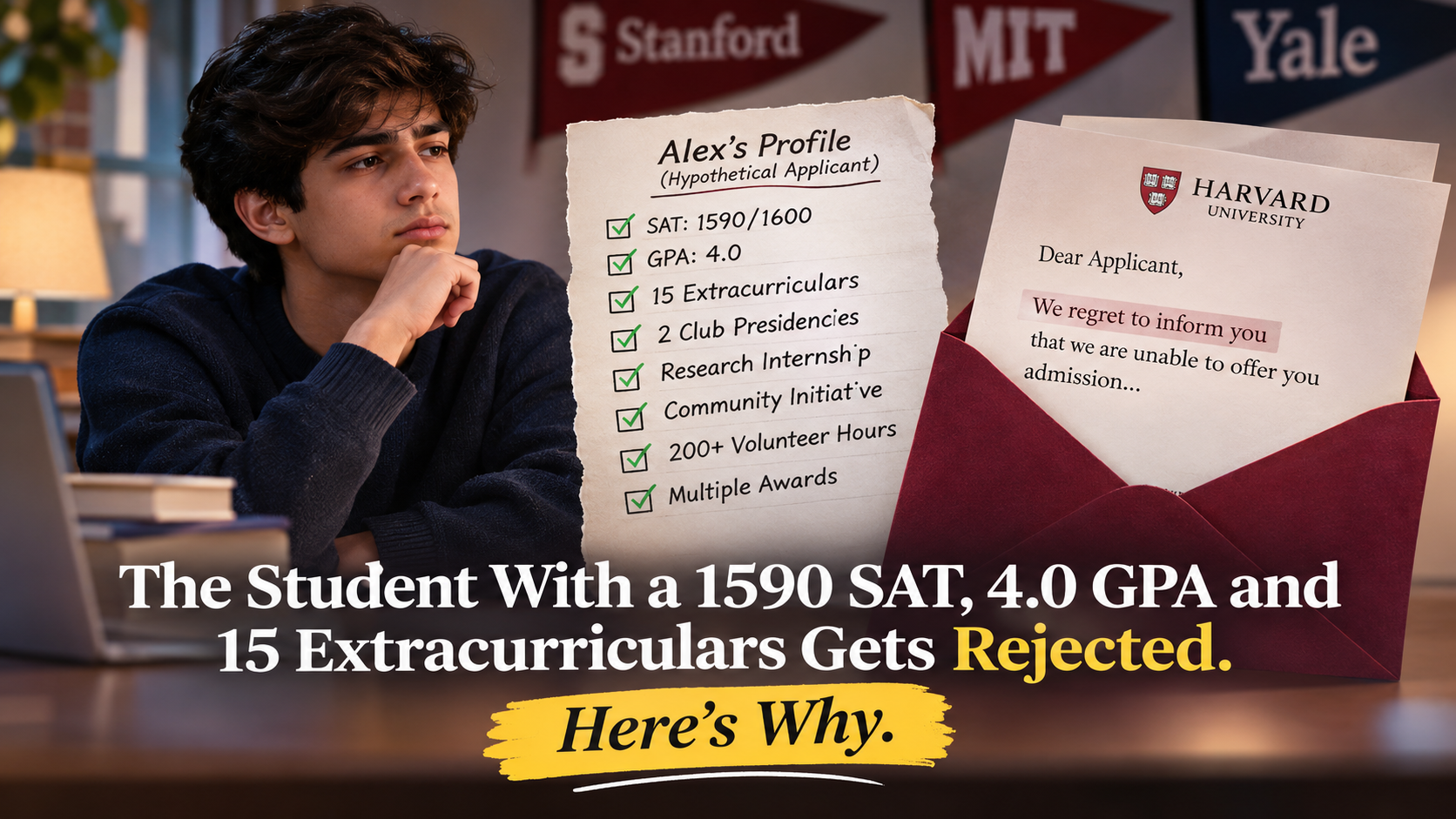
Alex is a hypothetical applicant. This story is illustrative and does not describe an actual student or admissions decision.
Alex has everything that parents dream of seeing on a college application.
SAT score: 1590/1600.
GPA: 4.0 unweighted.
Advanced coursework: A rigorous selection of AP and honors classes.
Extracurricular activities: 15.
Leadership: President of two school clubs.
Volunteering: 200+ hours.
Research: An internship at a university laboratory.
Awards: Multiple academic and extracurricular recognitions.
Alex has spent four years building what looks like an almost flawless application.
The college list includes Harvard, Stanford, MIT, Princeton, Yale and Columbia.
The application is submitted. The waiting begins.
Then the decisions arrive.
Rejected. Rejected. Rejected.
The obvious question follows:
How does a student with a 1590 SAT, a perfect GPA and an extraordinary extracurricular record fail to secure admission?
Did the universities overlook Alex's achievements?
Not necessarily.
Perhaps the problem was that Alex's application communicated a long list of accomplishments but failed to communicate something equally important:
Who is Alex beyond those accomplishments?
The Difference Between an Impressive Profile and a Compelling Applicant
There is a fundamental difference between having an impressive profile and presenting a compelling application.
An impressive profile tells an admissions officer what you have done.
A compelling application helps them understand:
Why you chose to do it.
What motivated you to pursue it.
What you learned along the way.
How your experiences shaped your thinking.
What you might contribute to the university community.
Consider two hypothetical applicants.
Applicant A: The Achievement Collector
Founded a nonprofit organisation.
Participated in three research projects.
Won several academic competitions.
Served as president of multiple clubs.
Completed multiple internships.
Applicant B: The Curious Problem Solver
Became interested in the difficulty younger students faced understanding mathematics.
Started tutoring five students in the neighbourhood.
Discovered that conventional teaching methods weren't working for everyone.
Developed visual learning resources to explain difficult concepts.
Expanded the initiative through school volunteers.
Began exploring how technology could make education more accessible.
Both applicants may have impressive achievements.
But Applicant B gives an admissions officer something more meaningful: a glimpse into how the student thinks, what interests them and how they respond to problems.
The difference isn't necessarily the scale of the achievement.
It's the meaning behind it.
Why 15 Extracurricular Activities May Not Be Better Than Five
One of the biggest misconceptions in college admissions is that more extracurricular activities automatically translate into a stronger application.
Students often approach extracurriculars like a checklist:
Join a debate club.
Participate in a Model United Nations conference.
Volunteer at an NGO.
Complete an internship.
Start a nonprofit.
Participate in a research project.
Become a club president.
Before long, the application looks impressive.
But a long activity list doesn't automatically demonstrate intellectual curiosity, initiative, commitment or leadership.
In fact, it can sometimes make it difficult to identify what genuinely matters to the applicant.
MIT Admissions explicitly encourages students to prioritise quality over quantity. Its admissions guidance emphasises pursuing activities that genuinely interest and challenge students rather than selecting them because they appear impressive on an application.
Harvard similarly states that it is more interested in the quality of extracurricular activities than their quantity.
The lesson?
Five meaningful activities can communicate more about a student than fifteen disconnected achievements.
This does not mean students should deliberately limit their activities. It means they should understand which experiences genuinely define them.
What Exactly Is a Personal Narrative in College Admissions?
The term personal narrative is frequently used in college admissions counselling, but it is often misunderstood.
A personal narrative is not necessarily a dramatic story about overcoming adversity. It does not require a student to have founded a successful company, conducted groundbreaking research or transformed an entire community. Nor does it mean that every extracurricular activity, academic choice and personal essay must revolve around a single subject.
Instead, a personal narrative is the underlying connection between a student's interests, experiences, decisions, motivations and aspirations.
Consider a hypothetical student interested in economics. The student's activities include participating in business competitions, completing an internship, studying consumer behaviour and volunteering with a local organisation. Individually, these experiences may seem unrelated. But suppose the student's interest in economics developed after observing how small businesses in the neighbourhood struggled with changing customer preferences and rising operating costs.
The student began exploring pricing strategies, researched consumer behaviour and eventually helped a local business understand its customer base more effectively.
Now the application communicates something more substantial. It reveals where the student's curiosity originated, how that curiosity developed and how the student explored it through different experiences.
The activities have not necessarily changed. The understanding of the student has.
This is what a compelling personal narrative can accomplish. It helps admissions officers recognise patterns of curiosity, initiative and personal development without making the application feel artificially constructed.
Importantly, a narrative should emerge from genuine experiences. Students should not manufacture a convenient identity simply because they believe a particular story will appeal to an admissions committee.
Authenticity matters because an application is evaluated through multiple components, including essays, recommendations, activities and academic records. A story that sounds impressive but does not reflect the student's actual experiences can create an inconsistent impression.
The Role of Essays: Giving Meaning to Your Achievements
The personal essay is one of the most important opportunities for students to communicate their individuality. Yet many applicants approach essay writing with the wrong objective.
They attempt to impress rather than reveal.
A student might write about winning a prestigious competition, founding a nonprofit or leading a large volunteering initiative. These experiences may be genuinely impressive, but simply describing the achievement does not necessarily help an admissions officer understand the student.
A stronger essay often explores a smaller, more personal moment. It might describe a failed experiment that changed the student's approach to problem-solving, an unexpected disagreement that challenged an existing belief or a seemingly ordinary experience that sparked a deeper intellectual interest.
The difference lies in reflection.
What did the student think before the experience? What changed during it? What did the student discover about themselves or the world around them? How did that discovery influence subsequent decisions?
These questions help transform an activity description into a meaningful personal account.
The same principle applies to supplemental essays. When a university asks why a student wants to attend its institution, the response should go beyond rankings, reputation, location and the availability of a particular major. A thoughtful answer should demonstrate an understanding of the university's academic environment, opportunities and community, while explaining why those elements connect with the applicant's interests and aspirations.
For example, an applicant interested in interdisciplinary research should be able to explain what kind of intellectual environment they hope to experience and why a particular university offers opportunities that align with those interests.
The objective is not to flatter the university. It is to establish a credible connection between the student and the institution.
Your Application Should Tell One Coherent Story Across Multiple Components
A common weakness in undergraduate applications is that different sections appear to describe different individuals.
The activities section highlights entrepreneurship, the personal essay focuses on a sporting achievement, the supplemental essays discuss an interest in environmental science, and the recommendations offer an entirely different perspective.
There is nothing inherently wrong with having diverse interests. Students are not expected to be one-dimensional, and a well-rounded set of experiences can be a genuine strength.
However, the application should provide a reasonably coherent understanding of the student's interests, values and personality.
Think of the application as a collection of different windows into the same individual.
The academic transcript demonstrates intellectual preparation and academic development. Extracurricular activities reveal how the student spends time outside the classroom and what they choose to pursue. Essays offer insight into motivations, perspectives and personal growth. Recommendations provide observations from people who have experienced the student's intellectual engagement, character and contributions.
Each component should add something meaningful rather than simply repeat information already presented elsewhere.
Harvard's admissions materials describe this approach as whole-person review, emphasising the importance of understanding an applicant's story rather than looking only at a list of achievements.
This is why application strategy cannot begin and end with writing the personal essay. The underlying story needs to be understood before the individual components are developed.
Five Questions Students Should Ask Before Applying to Top US Universities
Before finalising an undergraduate application, students should take a step back from their achievements and examine what those achievements communicate.
First, what genuinely excites you intellectually? If your grades, awards and certificates disappeared tomorrow, what would still make you curious enough to spend hours exploring a subject or solving a problem? Genuine intellectual curiosity often reveals itself through the questions students pursue without being asked.
Second, is there a connection between your experiences? Your activities do not need to fit into one perfectly defined theme, but it should be possible to understand why you chose certain opportunities and what you found meaningful about them. Look for recurring interests, motivations and values rather than trying to invent an artificial speciality.
Third, where have you demonstrated initiative? Have you identified a problem, explored an unfamiliar subject or taken responsibility for something without waiting for someone else to organise it? Initiative does not always require launching a large organisation. Sometimes it is reflected in the way a student approaches an ordinary opportunity.
Fourth, what have your experiences taught you? Admissions officers can already see the awards you have won and the positions you have held. What they may not understand without further context is how those experiences influenced your thinking, challenged your assumptions or changed your approach to future opportunities.
Finally, what would you contribute to a university community? Beyond your academic credentials, what perspectives, interests, experiences and qualities would you bring to your classmates? The answer does not need to be extraordinary, but it should be thoughtful and authentic.
These questions are not an admissions formula. No combination of answers guarantees an offer from an Ivy League university. They are intended to help students develop a clearer understanding of themselves and communicate that understanding effectively.
Stop Trying to Look Like the Ideal Applicant
Perhaps the biggest mistake students make is assuming that there is a universally accepted formula for admission to an elite American university.
There isn't.
Harvard acknowledges that successful applicants can distinguish themselves in very different ways. Some demonstrate exceptional academic promise through research or study, while others contribute across multiple areas or demonstrate extraordinary excellence in a particular pursuit. MIT similarly encourages applicants to pursue activities that genuinely interest and challenge them.
These perspectives challenge the idea that every student needs an identical collection of achievements.
A student who is deeply committed to classical music does not necessarily need to establish a technology nonprofit. An aspiring engineer does not need to become a nationally recognised debater. Someone with significant family responsibilities should not feel compelled to abandon those responsibilities to pursue activities that appear more impressive on an application.
The strongest application strategy begins with the individual rather than a checklist of achievements supposedly favoured by elite universities.
This does not mean students should ignore academic preparation, extracurricular development or strategic planning. All three remain important. It means these efforts should be grounded in genuine interests and developed with a clear understanding of what each experience contributes to the student's growth.
Ultimately, universities are not simply selecting the students with the most impressive-looking résumés. They are building communities of individuals who will learn from one another, contribute different perspectives and make use of the opportunities available to them.
That requires admissions officers to look beyond numbers and titles.
An Impressive Profile Gets You Noticed. A Compelling Application Helps You Become Memorable.
Let's return to Alex, our hypothetical applicant with a 1590 SAT, a 4.0 GPA and 15 extracurricular activities.
The lesson from Alex's story is not that academic excellence is irrelevant, or that a student should deliberately pursue fewer activities. It is that achievements, however impressive, cannot independently communicate the full identity of an applicant.
A strong application must help admissions officers understand the person behind the numbers. It should demonstrate academic readiness while revealing genuine interests, intellectual curiosity, initiative, character and the potential to contribute to a university community.
Students should continue to challenge themselves academically, explore opportunities and pursue excellence. But they should also spend time understanding why they make the choices they do, what they have learned from their experiences and what genuinely distinguishes their perspectives.
A 1590 SAT score can demonstrate exceptional academic ability. A perfect GPA can demonstrate years of academic consistency. Fifteen extracurricular activities can demonstrate considerable involvement.
But none of these, individually or collectively, automatically answers the most important question:
Who is the student behind the achievements, and what makes that student distinctive?
That is the question a compelling college application should help answer.
Is Your Application Impressive, or Is It Compelling?
At Wizius Careers, we believe that a successful undergraduate application begins with understanding the student, not simply organising a list of achievements.
Our undergraduate admissions consulting focuses on identifying each student's academic strengths, intellectual interests, experiences, motivations and aspirations. We work with students to develop an authentic application strategy that brings these elements together across their activities, essays, recommendations and university choices.
Because applying to Harvard, Stanford, MIT or any other highly selective university is not simply about demonstrating what you have accomplished. It is about helping the admissions committee understand who you are, what drives you and what you could bring to its community.
Wizius Careers — Better Prep. Better Scores. Better Schools.
Explore our undergraduate admissions consulting services at wiziuscareers.com.
Official References and Further Reading
Note: Alex is a fictional, illustrative applicant. The article does not claim that any particular admissions decision was caused by a lack of personal narrative. Admissions decisions are individual, contextual and multifactorial.